
Johnson County Release Date Labels
Texas records use several date labels because each marks a different stage. A parole eligibility date is when statutory consideration may begin. Projected Release Date, or PRD, is TDCJ’s conditional calculation. A later scheduled release date is an operational date created after approval and processing. Actual release is the event that ended the agency’s custody. Maximum expiration generally marks sentence discharge if no earlier release occurs.
| Date | Meaning | What it does not prove |
|---|---|---|
| Parole eligibility | The Board may consider release under the governing formula | Approval or physical release |
| Projected release | TDCJ estimate based on sentence, eligibility, credits, and status | A firm appointment at the gate |
| Scheduled release | Later operational date after release processing | That no last-day change can occur |
| Actual release | Recorded departure from that custodian | Freedom from a detainer or later supervision |
| Maximum expiration | End of the state sentence if no earlier lawful route applies | The same result as parole |
Find Johnson County Projected Release
Identify where the person is held. The TDCJ search applies to current state prisoners. Its form accepts last name, first name, TDCJ number, SID number, gender, and race. The minimum is a last name plus first initial, a TDCJ number, or a SID number. Exact identifiers reduce false matches. The tool updates on working days and its information is at least 24 hours old.
- Confirm whether the person is in Johnson County jail, TDCJ, federal custody, or ICE custody.
- For TDCJ, search the current record and copy every date with its displayed label.
- Check BPP status if parole or discretionary mandatory supervision may create an earlier route.
- After approval, ask whether a certificate, scheduled date, and scheduled location exist.
- On or after the date, confirm actual departure through the responsible agency record.
For a simple TDCJ inquiry, email pia@tdcj.texas.gov with the full name and seven-digit TDCJ number. If the number is unknown, provide exact date of birth, or approximate age and conviction county. TDCJ general information is also available weekdays from 8 a.m. to 5 p.m. at 936-295-6371 or 800-535-0283.
Keep a copy of the date and the time it was observed. TDCJ information is delayed, and the online profile may change or vanish after release. A saved label helps the agency understand whether the question concerns eligibility, PRD, scheduling, or actual departure. Never rewrite several fields as one generic release date.
Johnson County PRD Computation
TDCJ Classification and Records calculates PRD. The estimate asks when release from incarceration may occur if parole does not occur sooner. The formula depends on offense, offense date, sentence, calendar time, good-conduct classification, mandatory-supervision eligibility, Board decisions, program completion, residence planning, discipline, detainers, and the records audit.
The TDCJ projected release definition sets out how this calculation operates. The official definition is shown below.
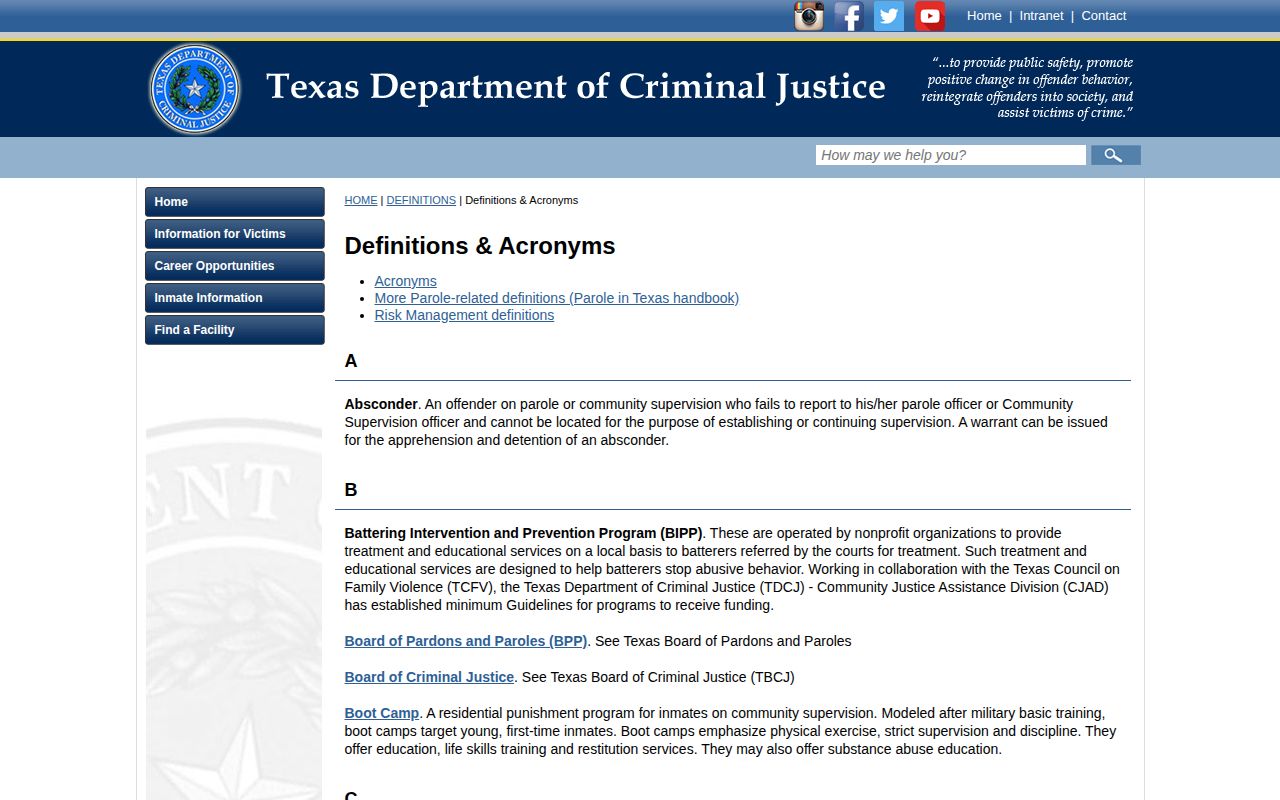
The agency definition shows why one percentage or a sentence-end subtraction cannot replace a current TDCJ calculation.
For older mandatory-supervision-eligible offenses before September 1, 1996, flat time plus good time can establish a projected mandatory release. For eligible offenses on or after that date, BPP approval under discretionary mandatory supervision also matters. A denial may reset PRD to maximum expiration, while a later approval can move it forward.
Johnson County Good-Time Rules
Texas has no universal rule that each prisoner serves 85 percent. Government Code Chapter 498 governs good-conduct time. Section 498.003 addresses accrual by classification, section 498.004 addresses loss and restoration, and section 498.005 says good time affects eligibility for parole or mandatory supervision but does not otherwise shorten the sentence itself.
Government Code Chapter 508 controls parole and mandatory supervision. Section 508.145(d) generally requires people serving listed serious offenses, including cross-referenced offenses and qualifying deadly-weapon cases, to serve actual calendar time equal to half the sentence or 30 years, whichever is less. For a sentence under four years, the minimum stated there is two calendar years. Other subsections carry other rules.
For many other cases, section 508.145(f) reaches eligibility when calendar time plus good time equals one quarter of the sentence or 15 years, whichever is less. Eligibility means the Board may consider release. It does not compel a favorable vote. Sections 508.147 and 508.149 govern mandatory supervision, including excluded offenses and discretionary review for many later cases.
What Changes Johnson County Dates
A PRD can move because the inputs or release decision change. The reason should come from the record, not an estimate based on the original sentence alone.
| Change | Possible effect | Confirmation source |
|---|---|---|
| BPP denial or later approval | May move PRD to maximum expiration or bring it forward | BPP decision and TDCJ detail |
| Good-time loss or restoration | Changes credit used in an eligibility calculation | Classification and Records |
| Program requirement | Can delay release after a favorable conditional vote | Vote code and release processing |
| Residence plan | Approval problems can hold scheduling | Parole Division release status |
| Detainer or hold | Can produce release to another custodian | TDCJ record and receiving agency |
| Sentence or records audit | May recalculate eligibility or expiration | Court record and Classification and Records |
TDCJ says Classification and Records normally takes about 14 to 21 business days to calculate a schedule after receiving a release certificate. Overall certificate processing may take about four to six weeks depending on the case. Those are process ranges, not promises for a named person.
When Johnson County PRD Passes
First verify the copied label. A passed parole eligibility date says only that review could occur. A passed PRD may have changed after a Board decision, discipline, program issue, detainer, or audit. A favorable vote may contain a code that requires a program. Even a scheduled date can change.
Check the current TDCJ detail and official BPP vote definition. After a favorable vote, call Parole Division release status at 512-406-5202. Ask whether a release certificate issued, whether a scheduled date and location exist, and whether a program, residence plan, detainer, disciplinary issue, or recalculation affects the case. Classification and Records can address time calculations, releases, detainers, and transfers at 936-437-6231 or classify@tdcj.texas.gov.
Note: Verify before traveling because a scheduled release location may differ from the current unit and can change during processing.
After Johnson County TDCJ Release
TDCJ’s public online search expressly covers people currently incarcerated in a TDCJ facility. A profile can disappear after release. That disappearance cannot certify the date or distinguish parole, flat discharge, or release to a detainer. Preserve proof through the release certificate, BPP and TDCJ response, assigned district parole office, or a public-information record.
Johnson County is cross-referenced to Fort Worth I District Parole Office, but an approved residence elsewhere can change the assignment. A district-office confirmation supports supervised release. Flat discharge should not be called parole. If a detainer caused transfer, the TDCJ confinement may have ended while custody continued elsewhere.
Johnson County Jail Release Dates
A Johnson County pretrial detainee may have no set release date. Release may depend on bond, a court order, case disposition, another hold, or transfer. For a local sentence, use the sentencing order, legally awarded credit, and the jail’s calculation. Do not import TDCJ’s PRD rules into an ordinary county misdemeanor sentence.
The Johnson County Out-of-Custody Jail Credit Request is a local proof route for relevant credit questions. Court records establish the sentence and orders. Johnson County Corrections establishes the movement or actual departure. If the jail reports transfer to Estes or another TDCJ facility, begin a separate state custody timeline. For a broader custody check, the Johnson County released-inmate record path explains how to reconcile the systems.
County release dates can also be affected by another county, federal, or ICE hold. Ending the Johnson County booking does not itself mean community release. Ask for the recorded movement code, its legend, and the receiving destination when public.
Pair the full name with a booking number, case number, date of birth where lawfully available, or state identifier. Two people can share a name, and one person can have both a county booking and a later TDCJ record. The event sequence shows whether the date belongs to the correct period of custody. Preserve each source and date label.
Public Record Search
Sponsored Results