
Johnson County Parole or Probation
The source of the order is the quickest way to distinguish the two. The Texas Board of Pardons and Paroles, usually called BPP, decides parole and discretionary mandatory supervision for people serving TDCJ sentences. The TDCJ Parole Division then prepares an approved case for release and supervises the person. Parole ends physical prison confinement before the sentence ends. Mandatory supervision is another supervised state release route for an eligible person. A flat discharge is different because the sentence expires with no parole term left.
Probation is court-ordered community supervision. Johnson County Community Supervision and Corrections Department, or CSCD, administers local misdemeanor and felony supervision, along with bond supervision and related services. Probation may follow time in the Johnson County jail, but it may also be ordered without state imprisonment. A probation order therefore cannot establish that someone left TDCJ.
| Question | Parole or mandatory supervision | Probation |
|---|---|---|
| Who authorizes it? | Texas BPP through the state release process | The trial court through its judgment or order |
| Who supervises? | TDCJ Parole Division and the assigned district office | Johnson County CSCD or a receiving county CSCD |
| Best proof | Release certificate, BPP status, and active office assignment | Court judgment plus CSCD confirmation |
| Does it prove freedom now? | No. A warrant or later detention may change custody. | No. A violation or new case may change custody. |
Verify Johnson County Parole Status
Start with identity and the state case. A full name should be paired with a TDCJ or SID number, date of birth, or conviction facts when available. The official parole review results guidance explains how to obtain the current decision. Before a vote, the BPP status line is 844-512-0461. After a favorable vote, TDCJ Parole Division release status is available at 512-406-5202. A favorable vote is authorization for a release path, not proof that the person passed through the gate.
Use a short verification sequence and retain the label used by each agency. A projected date, scheduled date, certificate, and active supervision assignment each describe a different stage.
- Confirm the TDCJ number or SID number and identify the state sentence.
- Check the BPP decision and read the official vote code rather than guessing from initials.
- Ask TDCJ release processing whether a certificate and scheduled release exist.
- Confirm the current district parole office after physical release.
- If present custody matters, check the relevant custodian because a historic release does not prove current freedom.
Johnson County Probation Verification
For probation, read the originating criminal judgment or community-supervision order. The Johnson County court chronology can show the disposition, sentence, conditions, later modifications, and violation filings. Then contact Johnson County CSCD with the case identifiers. Its services include misdemeanor and felony supervision, bond supervision, court services, a Transfer Out Unit, and Absconder/Fugitive Services.
A transfer-out entry matters. It means a Johnson County judgment may be supervised in another place, so the Cleburne office may route the inquiry rather than hold the current field assignment. Bond supervision is also distinct. It occurs while a case is pending and does not establish a conviction, prison release, parole, or completed sentence.
- Parole
- Conditional release from TDCJ custody while a state sentence continues.
- Probation
- Court-ordered community supervision administered by a CSCD.
- Mandatory supervision
- A supervised TDCJ release route controlled by eligibility law and, for many cases, BPP review.
- Discharge
- The end of a sentence or supervision term, not merely the day confinement ends.
- Absconder
- A supervised person whose whereabouts are unknown after reporting stops.
Johnson County Supervision Offices
Johnson County is assigned by the state county cross-reference to Fort Worth I District Parole Office in Region II. That is the sound starting point, but residence approval and later assignment can place a person elsewhere. The county probation office in Cleburne serves a different authority. Calling the wrong office can lead to a false negative even when supervision exists.
Fort Worth I District Parole Office
3628 McCart Avenue
Fort Worth, TX 76110
817-921-3537
Written parole supervision, location, or conduct questions: io@tdcj.texas.gov. Include the full name and TDCJ or SID number, or date of birth.
Johnson County CSCD Adult Probation
425 W. Chambers
Cleburne, TX 76033
817-556-6110
Fax: 817-556-6113
The official Region II office listing shows the state office details used for parole routing.
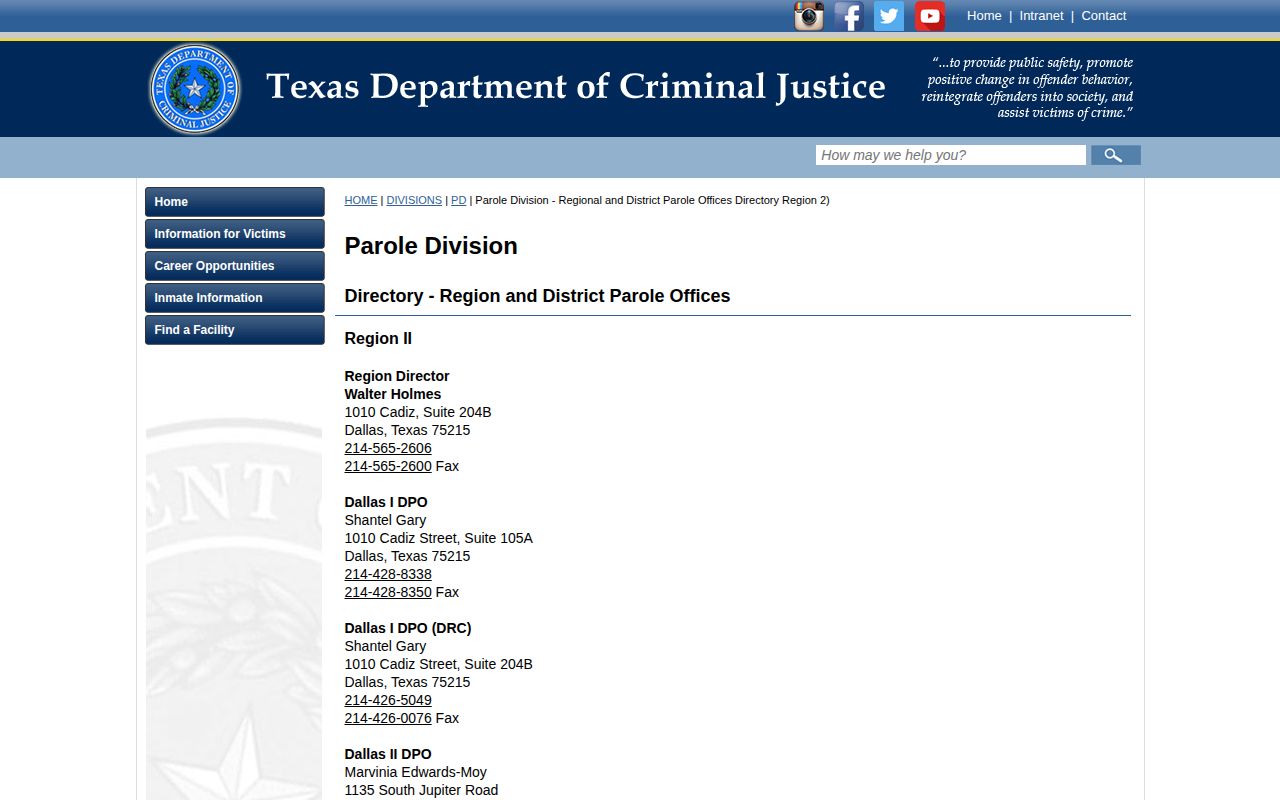
The office listing should be checked again when an address or assignment is time-sensitive, since the approved residence can change the correct parole office.
Johnson County Parole Decisions
BPP decisions and TDCJ release work must not be collapsed into one event. The Board reviews the file and records a vote. Some favorable codes call for release when eligible, while others require a program or another condition. TDCJ Review and Release Processing then handles the certificate, residence plan, program requirements, detainers, and operational schedule. A decision may therefore be favorable while the person remains confined.
Texas does not provide a standard public hearing date for ordinary review because there is no formal hearing in the usual case. A revocation hearing, clemency matter, or victim meeting is different. Review begins ahead of eligibility based on the Board process, and official vote definitions give the sound meaning of the outcome. Third-party summaries can omit conditions attached to the code.
Note: Treat BPP approval, TDCJ scheduling, physical release, and district-office assignment as four records rather than one interchangeable status.
Johnson County Warrants and Absconders
A parole absconder has stopped reporting and cannot be located by the supervising agency. TDCJ Warrants Command Center accepts anonymous information around the clock at 866-680-6667. That line is not a complete public lookup for every supervised person. The specialized public absconder search is limited to absconding sex offenders and cannot be used as a general parole-status index.
A parole warrant authorizes detention based on an alleged violation, new charge, or failure to report. It remains active until arrest or withdrawal. Johnson County CSCD lists Absconder/Fugitive Services for the local probation side. In either system, a past release certificate shows that confinement ended at one point. It does not prove the person is outside custody now.
Conditions vary by order and case. High-level verification may establish reporting, approved residence, program participation, or travel restrictions, but protected addresses and operational details should not be published. Use the agency and court record for the fact needed.
Johnson County Reentry Services
Johnson County’s local reentry landscape is split across state parole and county probation rather than one combined office. TDCJ parolees begin with the assigned district office, while people on probation use CSCD programs in Cleburne. The county lists psychological services, community service, court services, a payment center, transfer support, and supervision programs. The right entry point depends on the judgment or state release certificate.
This split affects practical requests. Someone asking about an approved parole residence should contact the assigned Parole Division office. Questions about a Johnson County probation condition belong with CSCD and the court. A person released on bond may instead have bond supervision while the case continues. Precise terms prevent an office from being asked to confirm a record it does not control.
For the underlying custody departure and release record, the Johnson County released-inmate search path separates the jail, TDCJ, and federal systems.
When Johnson County Supervision Ends
Supervision ends through a documented discharge, expiration, court action, or other lawful agency event. Flat discharge means a TDCJ sentence expired without a remaining parole term. Parole discharge occurs when the state sentence and supervision obligation end. Probation termination comes from the court record and CSCD file. The physical release date is not the same date as supervision discharge.
Government Code Chapter 508 governs parole and mandatory supervision. It sets eligibility and supervision rules, but it does not turn an estimated date into proof of release. For probation, the judgment and later court orders control. When the end date matters, ask for the existing discharge record or final order and match it to the same identity and case.
Note: A person can be out of a facility yet remain supervised, or have completed supervision and later enter custody on a new matter.
Public Record Search
Sponsored Results